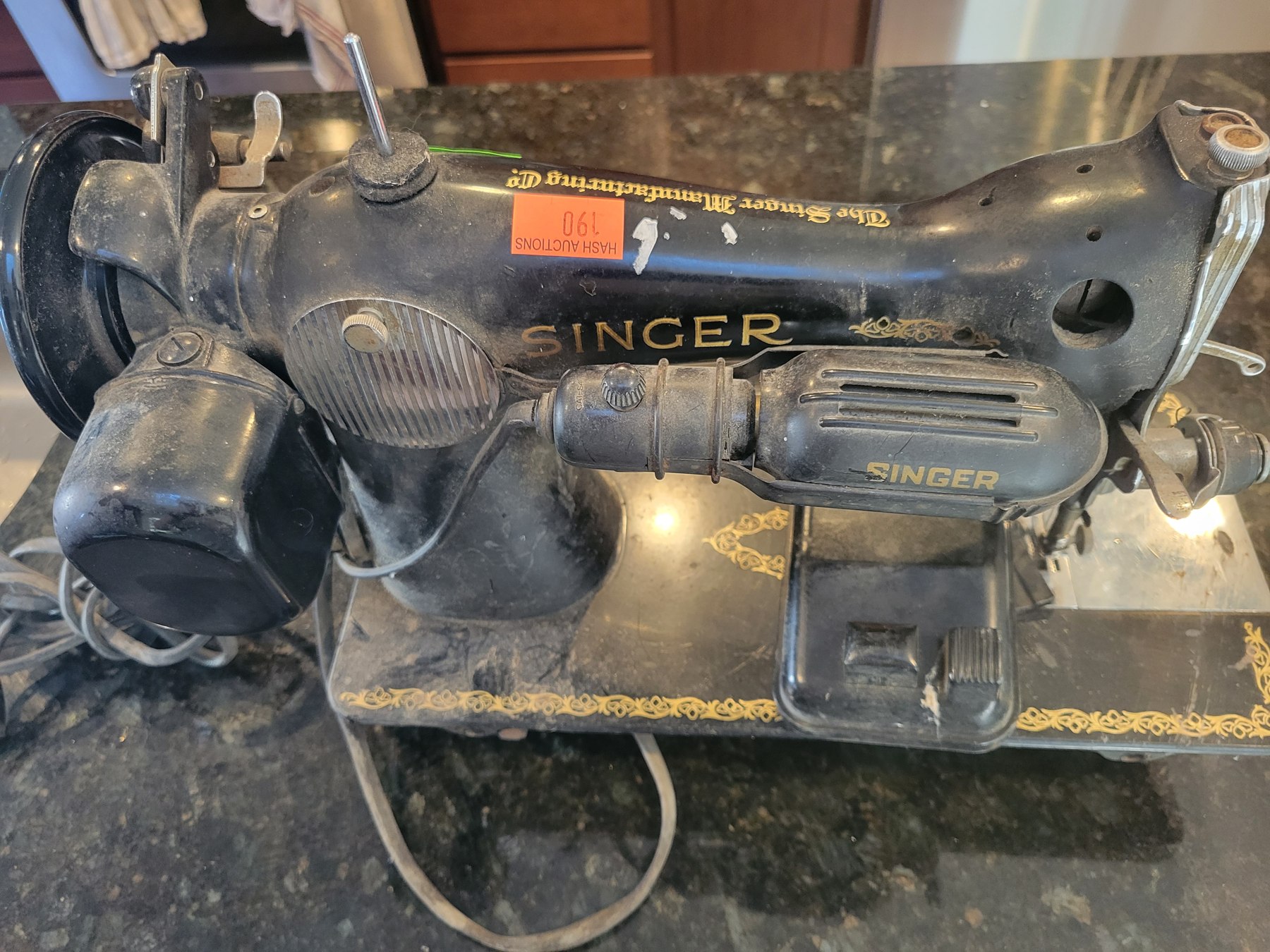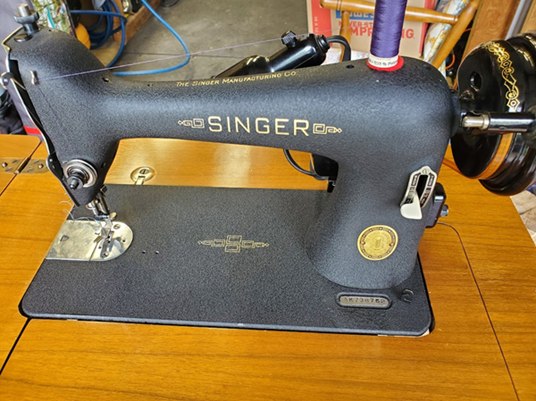
The Singer 15 is perhaps the most successful sewing-machine design ever, considering its long production history, the numbers made, and the many machines based on it. It is straightforward, robust, and useful for a wide variety of sewing. It was available in many configurations, from treadle and hand-crank machines to electric versions with an external belt-driven motor or a built-in potted motor. Its appeal goes beyond getting through a thick seam: a well-sorted machine can also make a tidy straight stitch on ordinary clothing and household fabrics.
Its history is just as interesting. The Singer 15 belongs to a long-running family of machines, and its influence extends to the many similar machines made by other manufacturers.
A Long Production History
The family’s roots lie in Singer’s nineteenth-century Improved Family machines. The Smithsonian preserves an original Singer List of Parts, I.F. Machine, dated to 1879–1889, alongside later instructions for several Class 15 variants. These documents show the design’s long history and the importance of distinguishing one version from another. Singer trade literature in the Smithsonian collections.
In my compilation of Singer serial-number records for 1900–1963, the 15 group accounts for 26,126,537 machines, approximately 33.9% of the total. It is the largest group in the analysis. Those figures cover the records and model designations I included; they are not a worldwide lifetime total, and they do not include other manufacturers’ copies. The Singer history overview explains the figures.
The end of that analysis is not the end of the Class 15 story. Singer India’s 2024–25 annual report still identifies Class 15 straight-stitch machines as a product category and describes a bearing update. That is evidence of the family’s longevity, although it does not mean that a modern machine is identical to a vintage 15-91. Singer India annual report.
Which Singer 15?
The number after “15” matters. These domestic machines are straight stitch only, with no built-in zigzag. Reverse depends on the subclass: the 15-88, 15-89, 15-90, and 15-91 have it, while earlier designs such as the 15-30, 15-86, and 15-87 do not. A treadle machine can have reverse, and an electric machine can lack it; the power source alone does not tell you. Singer's 15-88 and 15-89 instructions describe their reversible feed.
Two particularly useful comparisons are the 15-90, whose external motor drives a belt, and the 15-91, with its built-on geared motor, often called a potted motor. Singer’s original instructions identify their drive arrangements and describe reverse feeding. A manual for one subclass should not be treated as universal instructions for every Singer 15. 15-90 instructions; 15-91 instructions.
The 15-91 is a particular favorite of mine. A well-serviced example is a smooth, capable machine, with its compact potted motor driving the mechanism through gears rather than an external belt. Its appeal is the combination of a reassuringly solid feel and useful everyday sewing performance.
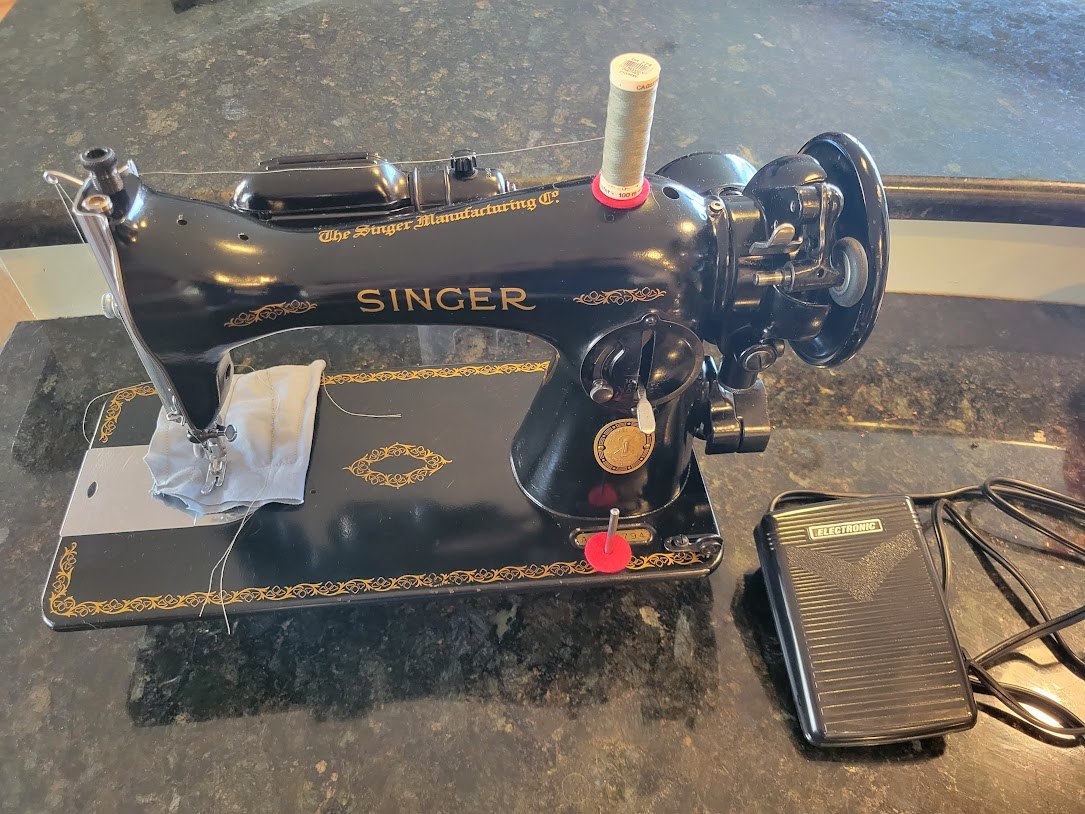
A Singer 15-91 with test fabric under the presser foot.
One quick visual clue is the upper-thread tension assembly: on the familiar domestic Singer 15, it projects from the faceplate at the left end of the machine, pointing to the left. On many other vintage Singers, including the Model 66, the tension assembly faces forward toward the person sewing. It is a useful detail to notice when looking through photographs or identifying an unfamiliar machine.
On electric examples, the light tends to sit at the back of the machine, unlike the front-mounted light on the Singer 201-2. Lighting arrangements can vary with the version and later modifications.
For identification, I would look at the machine as a whole: its bobbin arrangement, tension assembly, stitch-length control, drive, and markings. A serial number helps place a Singer in the records, but the subclass determines many of the practical details.
Selected Domestic Class 15 Submodels
This table covers several useful examples, rather than every Class 15 variant. Drive arrangements describe typical original configurations; surviving machines may have been converted.
| Submodel | Typical drive | Reverse | Feed dogs can be lowered | Distinguishing features |
|---|---|---|---|---|
| 15-30 | Treadle or hand crank | No | No | Spoked handwheel; plain stitch-length knob |
| 15-86 | Treadle | No | No | Spoked handwheel; rectangular stitch-length plate |
| 15-87 | External motor and belt | No | No | Solid handwheel; rectangular stitch-length plate |
| 15-88 | Treadle | Yes | Yes | Spoked handwheel; round stitch-length plate |
| 15-89 | Hand crank | Yes | Yes | Hand-driven counterpart to the 15-88 |
| 15-90 | External motor and belt | Yes | Yes | Solid handwheel; round stitch-length plate |
| 15-91 | Potted motor and gears | Yes | Yes | Built-on motor; no external drive belt |
| 15-75 | External motor and belt | Yes | Yes | Later restyled body; belt-driven counterpart to the 15-125 |
| 15-125 | Potted motor and gears | Yes | Yes | Later restyled body with built-in motor |
The table draws on Singer's original 15-86 manual, 15-86/87 parts list, 15-88/89 manual, and the 15-90 and 15-91 manuals linked above, together with the Needlebar subclass comparison and ISMACS Class 15 guide. Factory letters also appear in model designations: for example, a Kilbowie-built 15-88 is designated 15K88. Match the complete designation and mechanism when choosing a manual or replacement parts.
The Oscillating Hook and Class 15 Bobbin
In the familiar later domestic versions, a round bobbin sits in a removable bobbin case beneath the bed. The hook moves back and forth to carry the needle-thread loop around the bobbin assembly and form the lockstitch. Singer describes the 15-90 as having an oscillating shuttle on a horizontal axis. “Oscillating” describes that mechanism’s movement; the bobbin itself pays out the lower thread. Singer’s 15-90 instructions.
The Class 15 bobbin also offers useful thread capacity. It is taller than a Class 66 bobbin of similar diameter, providing room for more thread when comparing otherwise similar bobbins. The practical benefit is fewer stops to refill it. Actual capacity depends on the thread and how it is wound, so I would avoid assigning a universal yardage or percentage advantage. Supplier bobbin dimensions.
Bobbins that look similar are not necessarily interchangeable. Use the type specified for the machine, and check its bobbin case and threading instructions. Singer’s own bobbin guidance distinguishes Class 15, Class 15J, and Class 66 rather than treating them as substitutes. Singer bobbin guidance.
What Makes It Useful at the Sewing Table?
For me, the attraction is a solid straight-stitch machine with a simple job to do. Clothing repairs, quilt piecing, household sewing, and suitable bag or outdoor projects can all fall within its working range. The fabric, seam construction, needle, thread, and condition of the particular machine matter more than an impressive stack of scraps in a demonstration.
The 15’s reputation for strength should not obscure its usefulness on lighter work. Matching the setup to the fabric matters at both ends of the range. Singer’s 15-90 manual includes adjustments and attachments for tasks beyond a basic seam, including darning and embroidery. Original instructions and attachment guide.
For repeated bulky seams or demanding heavy-material work, feeding and sustained operation become as important as needle penetration. My Vintage Sewing Machine Tropes article discusses why a strong domestic machine and an industrial machine serve different needs.
There is also an interesting detail behind the familiar “all metal” description. Singer’s original 15-91 parts list identifies a Textolite balance-wheel gear. The machine can be robust without every component being metal. Singer 15-91 parts list.
Japanese Class 15-Type Machines and Their Wider Legacy
The colorful Japanese machines commonly called “Singer 15 clones” deserve their own place in this story. My collection notes include names such as Royal, Peerless, Modernage, and Deluxe Precision. The name on the badge is a starting point for identification; it does not, by itself, establish the factory that made the machine.
It is tempting to begin this history immediately after WWII, but Japanese domestic-machine development was already underway. Janome documents a 1929 Model 30 with a vertical half-turn shuttle, and Brother dates its first home straight-lockstitch machine to 1932. These company histories establish a substantial prewar background. Janome history; Brother history.
The postwar period brought another important development: HA-1 standardization. Janome’s history describes the unification of household-machine dimensions under that designation in 1948. JUKI dates its first HA-1 household machine to 1947 and records the start of exports to the United States that year. Together these sources give us a better foundation than an account in which Japan’s sewing-machine industry suddenly appeared after the war. Janome history; JUKI history.
Many examples are worth considering as working machines in their own right. I would judge an individual example by its construction, condition, completeness, and sewing results. Similarity to a Singer 15 does not guarantee that every part, bobbin case, or threading instruction will transfer unchanged.
The wider story includes later manufacture outside Japan. Singer India’s continuing Class 15 category is one documented branch. Chinese manufacturer listings also show JA-series household machines, although a product designation alone does not establish a complete design lineage. For individual clones, factory markings, original manuals, and parts lists are the best starting points. Singer India annual report; Qilong manufacturer listing.
Owning and Refurbishing a Model 15
Before putting an unfamiliar machine to work, I want to know which version it is, whether its moving parts operate freely, and whether the electrical equipment is sound. I also check that the bobbin and case belong together and that the machine is threaded according to its own instructions.
My refurbishment overview explains the broader process. For a Model 15, the drive arrangement deserves particular attention: a belt-driven machine and a potted-motor machine need different work. Cleaning, lubrication, adjustments, and a test sew on the intended materials help reveal what the machine actually needs.
The best reason to keep a Singer 15 working is that it remains useful. Its long history and the many related machines make it rewarding to collect, but a good example earns its place at the sewing table.
Additional Information
Original Documentation and Historical Sources
- Singer 15-90 instruction manual: operation, bobbin handling, adjustments, and attachments for the belt-driven version.
- Singer 15-91 instruction manual: instructions for the potted-motor version.
- Singer 15-91 parts list: original component names and part numbers.
- Smithsonian Singer trade-literature collection: original manuals and catalogs, including Improved Family, Class 15, and 15-88/89 material.
- Janome’s company history, Brother’s history, and JUKI’s history: manufacturer accounts of Japanese development and the HA-1 era.
Collector References
- Singer Sewing Info: Model 15 and 15K: a collector reference for variants, identifying features, and later examples.
- ISMACS Singer serial-number database: the source tables behind the production analysis on this site.
Videos from My Recommended Channels
- Bob Fowler: Singer 15 series, a collection of model-specific repair videos. For a project sequence, start with Singer 15-91 Overhaul: Day 1. His Freeing a Seized 15-91 series continues with reassembly and timing.
- Vintage Sewing Machine Garage: Singer 15 history and heritage, 15-30 shuttle, race, and bobbin-case reassembly, and threading a Class 15 clone.
- Curio by B-Spoke Designs: Restoring a Vintage Singer 15K, Part 1 and Part 2, plus an Alfa Model 50, described as a Singer 15 clone.
Match any demonstration to your exact machine before using it as a repair guide. My YouTube resources page introduces these channels and the other creators I follow.
Have a machine or a question to share?
Get in touch with Duncan ↗