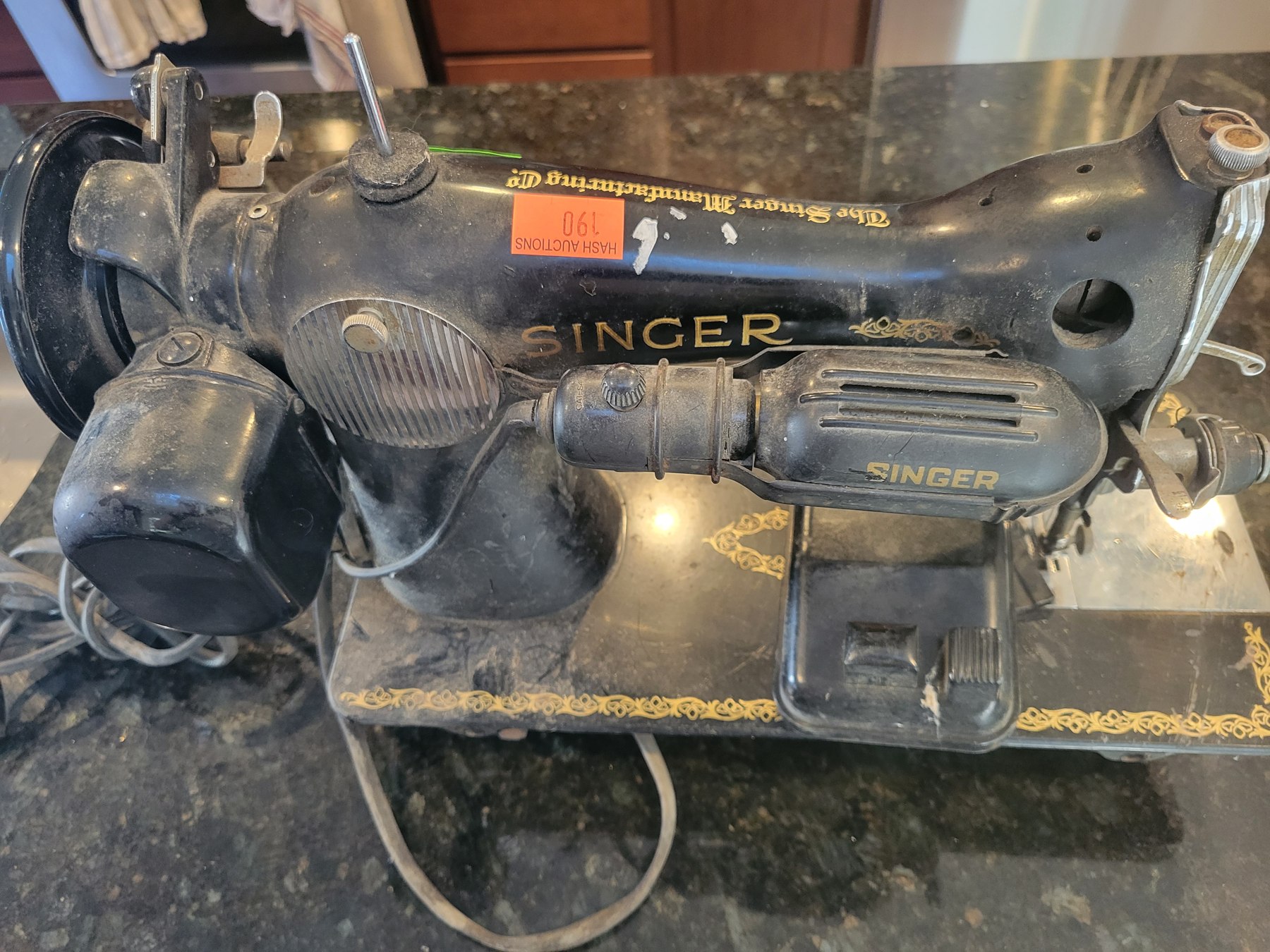
The Singer 66 brings together two things I enjoy about vintage sewing machines: a useful, straightforward mechanism and decoration worth stopping to look at. A good example can still earn its place at the sewing table, while a colorful Red Eye or Lotus pattern makes it easy to understand the appeal to collectors.
It is a full-size domestic straight-stitch machine. You will find it in treadle cabinets, with hand cranks, and with electric motors. The drive arrangement is only part of its identity; the bobbin system and the details of the particular version matter too.
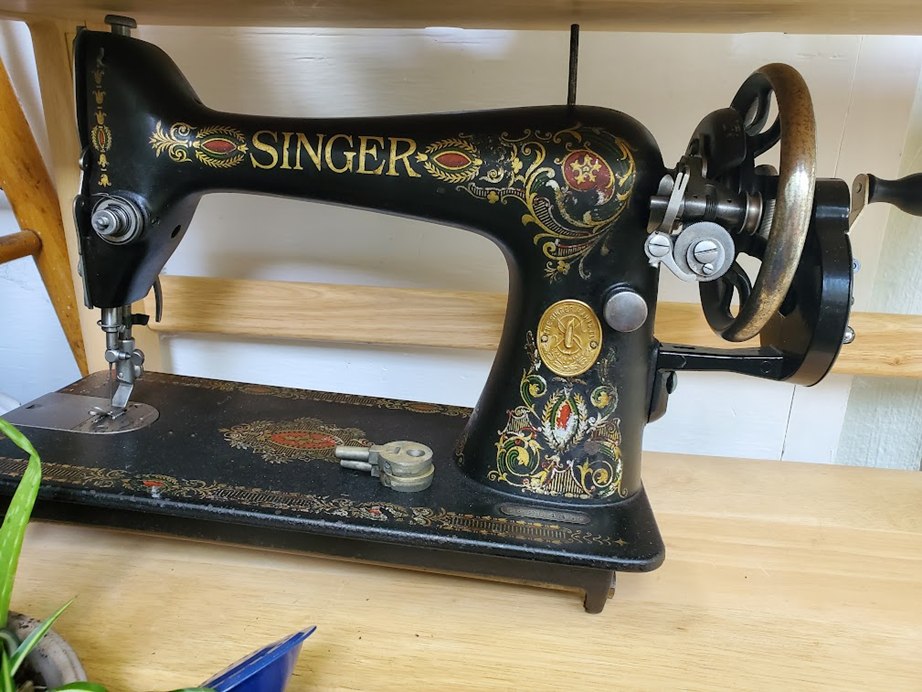
A Red Eye Model 66 with a hand crank. The red and gold decoration is one of the model's most recognizable features.
A Long Production Run
In my compilation of Singer serial-number records, the 66 group accounts for 8,906,297 machines, about 11.5% of the recorded total. The group's earliest entry is in 1902 and its latest in 1956. These are the dates and allocated quantities represented in my dataset, rather than a claim that every machine was completed in its allocation year or that the figures cover all production worldwide.
The Singer history overview puts those numbers alongside the other domestic models. The smaller Model 99 is counted separately.
The 66 was made in more than one factory. British-made examples carry the 66K designation, with the K identifying Singer's Kilbowie factory in Scotland. The production histories of the American 66 and British 66K do not have identical start and end dates. Singer Sewing Info's Model 66 guide provides a useful introduction to those differences.
The Drop-In Bobbin
The bobbin is one of the 66's most appealing everyday features. Open the slide plate beside the needle plate and the bobbin is accessible from above. It lies flat in its holder, so routine bobbin changes do not require taking out a separate bobbin case as they do on the Singer 15.
“Drop-in” describes how the bobbin is loaded. The hook underneath is oscillating: it swings back and forth as part of forming the stitch. It is useful to keep those two descriptions separate, since a top-loading bobbin does not by itself tell you whether a machine has an oscillating or a rotary hook. Singer's original parts documentation identifies the Class 66 oscillating hook. Singer Class 66 parts list.
The Class 66 bobbin is shallower than a Class 15 bobbin. Use the correct bobbin and follow the threading path in the instructions for your machine; a bobbin that fits into the opening is not necessarily the right one. Singer's own instructions show bobbin insertion and threading, along with the upper-thread path. Original Model 66 instructions.
There is another visible contrast with the 15: the 66's upper tension assembly faces forward toward the person sewing. The familiar domestic 15 carries its tension assembly on the faceplate, projecting to the left.
Red Eye, Lotus, and Other Decoration
The Red Eye pattern is probably the first decoration many people associate with a Singer 66. Its red accents and elaborate gold ornament give the machine a very different appearance from later examples with simpler decoration. It is an attractive reason to choose a machine, although the decal pattern does not change how its stitch mechanism works.
That said, the “Godzilla” finish 66 might actually be my favorite. The textured finish and simpler gold decoration give it a character all its own.
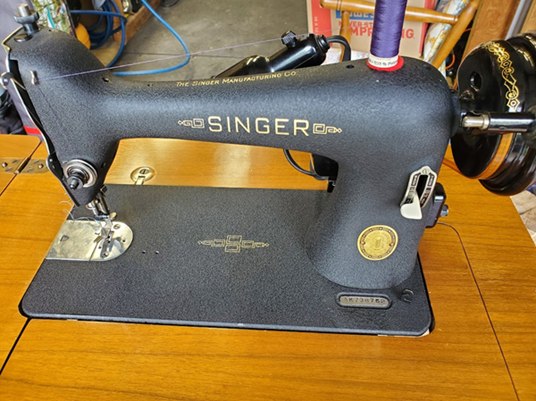
A Godzilla-finish Singer 66 from my records, showing its textured surface and simpler decoration.
The Lotus pattern is another striking example associated with the 66K. Other 66K examples carry Sphinx decoration or simpler later designs. Names such as Red Eye and Lotus are commonly used collector descriptions; terminology can vary between references.
For comparing patterns, the Singer Sewing Info decal gallery is an excellent visual reference. It covers many Singer models, so finding a matching pattern is a useful clue rather than a complete model identification.
Decoration also deserves care during refurbishment. I want to preserve surviving decals and finish wherever practical. An aggressive cleaning approach can turn a dirty but attractive machine into a clean machine with missing decoration. My refurbishment overview describes how finish preservation fits into the broader process.
A beautiful Red Eye is not automatically a rare machine. Condition, originality, completeness, and a genuinely unusual variant are separate questions. The discussion of rarity in Vintage Sewing Machine Tropes explains why I try to keep those distinctions clear.
Details That Vary Between Machines
On electric examples, the light tends to sit at the back of the machine, unlike the front-mounted light on the Singer 201-2. Lighting arrangements can vary with the version and later modifications.
The family changed over its production life. Before choosing accessories or following a repair demonstration, there are several details worth checking:
- Presser-foot attachment. Early examples can have back-clamping feet; later examples use side-clamping feet. Check the attachment point before assuming that an otherwise familiar foot will fit.
- Stitch-length control. Some machines have a screw adjustment, while later versions have a lever. The control's appearance is a useful identification clue.
- Reverse or back-tacking. Many examples sew forward only. Some later versions provide back-tacking, so check the specific version rather than assuming that every 66 has the same capability.
- Drive and bobbin winder. Treadle, hand-crank, and electric configurations occur, and bobbin-winder arrangements also vary. A surviving machine may have been converted during its working life.
The collector's Model 66 guide illustrates several of these differences. Original instructions and parts lists remain the better starting point for the exact machine on the bench.
The 66 and the Smaller 99
The Model 99 is the smaller companion to the 66 and can look very similar in a photograph without a sense of scale. Both use the familiar Class 66 bobbin arrangement, but they should not be treated as the same model. Check dimensions, identification details, and serial-number records instead of relying on the decal pattern alone.
That distinction matters in the production analysis, too: the 66 and 99 occupy separate groups. It also matters when choosing a cabinet or carrying case.
Using and Refurbishing a 66
For ordinary straight-stitch work, a well-adjusted 66 remains a useful machine. Its appeal is easy to appreciate in clothing repairs, piecing, and household sewing: a substantial machine, accessible bobbin, and relatively simple controls. As with the 15, the right needle, thread, fabric, and seam construction matter more than a claim that an old machine can sew through anything.
I check the bobbin area, feed mechanism, tension assembly, and drive as part of the refurbishment process. On a treadle machine, the table and drive need attention as well as the head. On an electric example, the motor, wiring, and controller are part of the assessment.
The 66 makes a satisfying working collectible because its usefulness and appearance complement each other. The decals draw you in; a good test sew is what makes you want to keep using it.
Additional Information
Original Singer Documentation
- Singer Model 66 instruction manual, hosted by ISMACS: an original guide to operation, threading, and adjustment. Match the illustrated controls to your version.
- Singer parts list for 66-14, 66-15, 66-18, and 66-24: original component names and diagrams for the listed subclasses.
Collector and Historical References
- Singer Sewing Info: Model 66 and 66K: photographs, variants, and identifying details.
- Singer Sewing Info: decal-pattern gallery: a visual guide to decoration across Singer models.
- ISMACS Singer serial-number database: the records behind the Singer history analysis on this site.
Videos from My Recommended Channels
- Bob Fowler: Singer 66 playlist, including focused repair topics. Also see removing and replacing the hook and setting the timing, refreshing an older 66 bobbin winder, and older Singer 15 and 66 upper-thread tension units.
- Curio by B-Spoke Designs: Singer 66 or 99: how to tell the difference and a Singer 66 Lotus in a Model 21 parlour cabinet.
My YouTube resources page introduces these channels. As always, compare the machine in a demonstration with your particular version before applying its instructions.
Have a machine or a question to share?
Get in touch with Duncan ↗